
Hi, I am Diksha :)
I study how neural networks solve complex cognitive tasks, and diagnose when and how they fail. My interests lie at the intersection of LLM training dynamics, alignment, and interpretability.
I am currently a senior research fellow at Pivotal, working with Stefan Heimersheim on the continuity of LLM activation manifolds and what that implies for manifold-aware steering and probing. Previously, I worked on red-teaming unlearning methods for open-weight safety.
Before that, I was a senior research fellow at the Sainsbury Wellcome Centre at University College London, with the Behrens and Mrsic-Flogel labs, studying compositional representations and their learning algorithms in artificial and biological neural networks. During my PhD with Carlos Brody at Princeton University, I developed ablation-aware methods to train RNNs on cognitive tasks to improve capability attribution, and better models to track systematic biases in decision-making and predict previously unpredictable failures, working from neural recordings and causal experiments in rodents playing carefully crafted structured games.
Education and Positions
Projects
 LLMsStructure & attribution
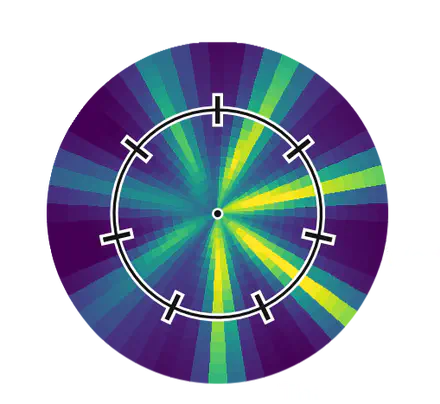
Representation Structure in LLMs
Recent work has hypothesised that large language models may represent some concepts as multi-dimensional manifolds instead of single directions. This has encouraged new steering and probing methods that respect manifold geometry. …
LLMsStructure & attribution
Representation Structure in LLMs
Recent work has hypothesised that large language models may represent some concepts as multi-dimensional manifolds instead of single directions. This has encouraged new steering and probing methods that respect manifold geometry. …
 LLMsFailure modes
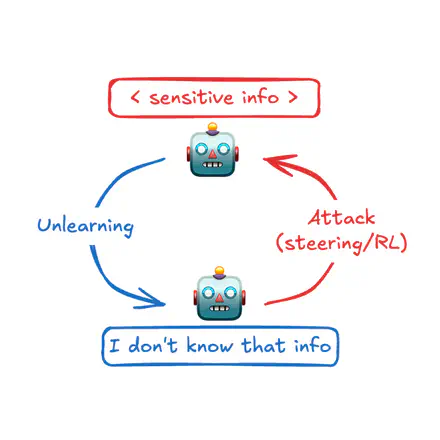
Knowledge Removal in LLMs
A large portion of safety and alignment research has focused on closed frontier models, due to their advanced capabilities. However, the gap between open and closed models is narrowing fast, and open-weight models are now being …
LLMsFailure modes
Knowledge Removal in LLMs
A large portion of safety and alignment research has focused on closed frontier models, due to their advanced capabilities. However, the gap between open and closed models is narrowing fast, and open-weight models are now being …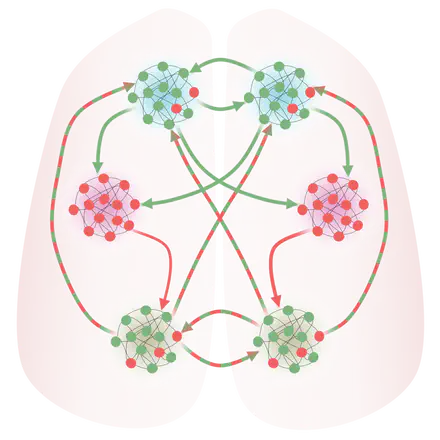 BrainsStructure & attribution
Mechanistic Attribution in Decision Circuits
I am fascinated by how intelligent behavior emerges from the coordinated activity of networks of neurons. This page highlights my research aimed at uncovering the representations, architectures, and dynamics that are crucial for …
BrainsStructure & attribution
Mechanistic Attribution in Decision Circuits
I am fascinated by how intelligent behavior emerges from the coordinated activity of networks of neurons. This page highlights my research aimed at uncovering the representations, architectures, and dynamics that are crucial for …
 BrainsFailure modes
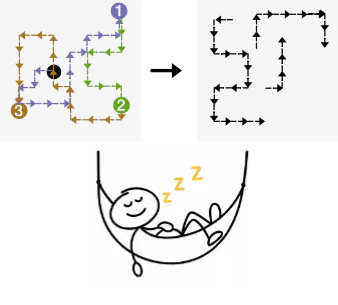
Failure Modes in Sequential Decisions
Neural activations are messy and complicated, so the behaviour of an agent often constrains a system’s computational model more tightly than measurements of its internals (Niv 2021). A large part of my research focuses on …
BrainsFailure modes
Failure Modes in Sequential Decisions
Neural activations are messy and complicated, so the behaviour of an agent often constrains a system’s computational model more tightly than measurements of its internals (Niv 2021). A large part of my research focuses on …Recent Blogposts
Peer-reviewed publications
Organising & Teaching
Organising
- 2026 Barcelona Advanced Modeling of Behavior (BAMB!) summer school, Barcelona - organiser
- 2026 Replaying the future: neural mechanisms of generative replay - COSYNE 2026 workshop, co-organiser with Kristopher Jensen and Eleanor Spens
- 2024–25 Emerging Neuroscientists Seminar Series (ENSS), Sainsbury Wellcome Centre - organiser
Teaching
- 2024–25 Barcelona Advanced Modeling of Behavior (BAMB!) summer school, Barcelona - teaching assistant
- 2023 Neuromatch Academy, computational neuroscience track - project mentor
- 2021 Neuromatch Academy, computational neuroscience track - project TA for 11 student teams
- 2017 Introduction to Neuroscience (NEU 175, undergraduate), Princeton University - teaching assistant
- 2016 Introduction to Neuroscience (NEU 501A, graduate), Princeton University - teaching assistant
Talks
- Aug 2026 Pivotal Spotlight, London Initiative for Safe AI (LISA) selected representation structure
- Aug 2026 Pivotal Lightning talk, UK AISI selected representation structure
- May 2026 Symposium on Biology of Decision Making (SBDM), Paris invited failure modes
- Mar 2026 IDIBAPS - Institut d’Investigacions Biomèdiques August Pi i Sunyer, Barcelona invited decision circuits
- Dec 2025 AI Research Afternoon, Faculty of Life Sciences, University College London invited decision circuits
- Nov 2025 Minisymposium, Society for Neuroscience annual meeting invited decision circuits
- Nov 2023 Colloquium, Leiden Institute for Brain and Cognition, Leiden University invited failure modes
- Oct 2023 Society for Neuroeconomics annual meeting selected Travel Award failure modes
- Oct 2023 Brain Stories Live, Episode 18: Neuro AI - public panel at the Bloomsbury Theatre, with Rick Adams and Benedetto De Martino panel listen
- Sep 2023 Analytical Connectionism Workshop, Gatsby Computational Neuroscience Unit selected decision circuits
- Mar 2023 Computational and Systems Neuroscience (COSYNE) conference selected top 3% of abstracts decision circuits
- June 2022 Reinforcement Learning and Decision Making (RLDM) conference selected Best Paper Award failure modes
- May 2022 Annual retreat, Princeton Neuroscience Institute invited decision circuits
- Apr 2022 Center for Neural Science, New York University invited decision circuits
- Mar 2022 Computational Cognitive Neuroscience seminar, UMC Hamburg-Eppendorf invited failure modes
- Mar 2022 HHMI Janelia Research Campus invited decision circuits
- Oct 2021 Experimental Psychology seminar, Bolivian Catholic University invited decision circuits